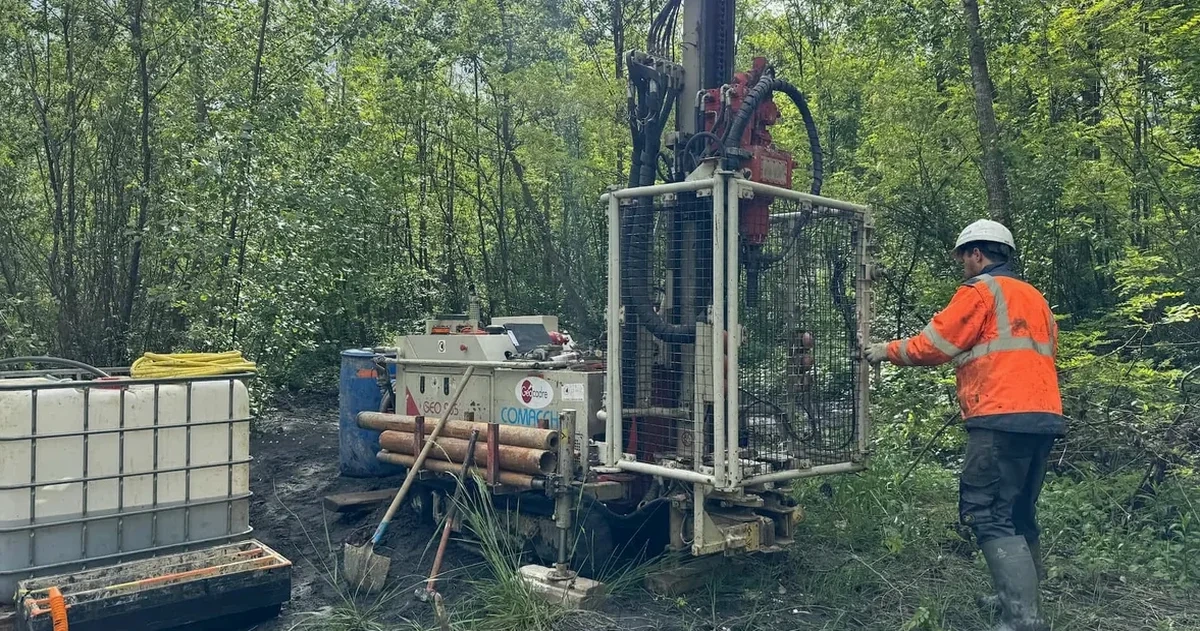
The most repeated mistake on Tucson job sites is treating basin-fill deposits like standard granular soil. When a contractor in the Rincon Valley footwall area drills 30 feet of sandy gravel and assumes 3,000 psf bearing without a soil mechanics study, the calcrete lenses and collapse-prone silts that went undetected can trigger differential settlement within the first monsoon cycle. A proper soil mechanics study in Tucson doesn't just log cuttings—it quantifies cementation variability, moisture sensitivity, and the shear strength reduction that occurs when arid soils first encounter water. Our laboratory runs ASTM D2487 classification with wash-sieve hydrometer on every sample, because the fines content in Tucson alluvium often exceeds 15 percent even when the field description says "clean sand." For deeper strata where basin geometry influences load distribution, we pair the study with CPT testing to capture continuous tip resistance and sleeve friction profiles through interbedded hardpan layers that SPT alone cannot resolve.
Tucson basin-fill soils lose up to 40 percent of their apparent bearing capacity when saturated—a soil mechanics study must measure that reduction, not assume it.
How we work
At 2,389 feet of elevation and sitting within the Basin and Range physiographic province, Tucson’s subsurface is a mosaic of Holocene stream-channel deposits, Pleistocene piedmont alluvium, and the notorious caliche horizons that form pedogenic calcium-carbonate hardpans. A soil mechanics study here must address three failure mechanisms that standard lab schedules miss: hydrocompaction in low-density silty sands below 110 pcf dry unit weight, caliche dissolution piping where urban irrigation alters groundwater chemistry, and the stiffness contrast where young alluvium abuts Tertiary conglomerate at the mountain front. We run consolidated-undrained triaxial with pore pressure measurement on undisturbed Shelby tube samples because effective-stress parameters control slope stability in the Catalina Foothills, where luxury homes are cut into colluvial wedges. When the project involves mat foundations on expansive claystone weathered from the Pantano Formation, we integrate Atterberg limits and swell-consolidation testing to define the active zone depth—which in Tucson routinely exceeds 8 feet due to the arid surface moisture deficit and deep evapotranspiration drawdown.
Local ground factors
Comparing a project near the Santa Cruz River floodplain in the Flowing Wells area with one on the fan terraces of Oro Valley reveals the risk spread that a soil mechanics study in Tucson must bracket. Flowing Wells sits on interbedded silty sand and clay with groundwater at 15 feet, where cyclic mobility during a design-basis earthquake on the Santa Rita fault segment can generate excess pore pressure and foundation rocking. Oro Valley, by contrast, has deep vadose-zone caliche with UCS values above 800 psi—until a roof-leader downspout or landscape drip system dissolves the cementation over five monsoon seasons and creates a collapse sinkhole under the slab-on-grade. The soil mechanics study quantifies both scenarios: seismic-induced strength loss using Seed–Idriss simplified procedure calibrated to Tucson’s mapped NEHRP site class C/D boundaries, and metastable soil collapse strain from paired dry-wet oedometer curves. Skipping this analysis because "the footing inspection passed" is how a $600,000 custom home becomes a litigation file after the first 100-year storm delivers 3 inches of rain in two hours across the Tucson basin.
Quick answers
What does a soil mechanics study in Tucson typically cost for a single-family home lot?
For a standard residential parcel in Tucson requiring a drill rig, laboratory testing, and a geotechnical report with foundation recommendations, the investment generally falls between US$3,280 and US$4,730 depending on access constraints, depth of investigation, and whether undisturbed sampling for collapsible soil testing is required by the Pima County building official.
How deep should borings go for a soil mechanics study in Tucson’s basin-fill deposits?
For shallow foundations on Tucson basin-fill, borings extend to 1.5 times the footing width below the bearing elevation, typically 20 to 30 feet. Where caliche layers are intermittent or groundwater is within 50 feet, we deepen borings to 50 feet and add CPT soundings to confirm continuity of the cemented stratum. Deep foundation investigations for piers or piles routinely reach 80 to 120 feet to penetrate the younger alluvium and seat in the Pantano Formation or older conglomerate.
Can I use a standard proctor test instead of a full soil mechanics study for a retaining wall in Tucson?
A proctor test provides compaction parameters for the backfill, but it does not measure the shear strength of the foundation soil, the lateral earth pressure coefficient, or the collapse potential of the retained material—all of which a soil mechanics study quantifies. Tucson’s cemented alluvium can stand on near-vertical cuts during excavation but lose cohesion rapidly with wetting, so the study includes drained direct shear on undisturbed samples at field moisture and after saturation to capture both conditions.
What seismic parameters does a Tucson soil mechanics study provide for structural design?
The study delivers the site class (C, D, or occasionally B for shallow bedrock at the mountain front), the mapped spectral acceleration parameters Ss and S1 per ASCE 7-22, the site coefficients Fa and Fv, and the design response spectrum. For sites within the Santa Cruz River alluvial corridor, we also screen for liquefaction and carry out post-liquefaction residual strength if the factor of safety falls below 1.1.
How long does a soil mechanics study take from drilling to final report for a Tucson commercial project?
Field drilling and sampling for a typical Tucson commercial site is completed in 2 to 4 days. Laboratory testing adds 10 to 15 business days for classification, triaxial, consolidation, and collapse/swell tests. The geotechnical report with foundation recommendations, seismic parameters, and construction considerations is delivered in 3 to 4 weeks from mobilization, provided utility clearances and right-of-entry are in place.