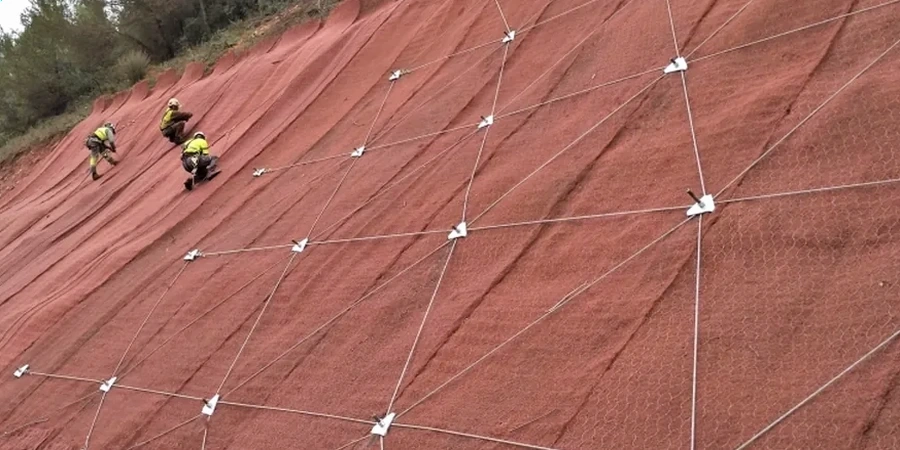
Tucson sits at roughly 2,400 feet above sea level, cradled by five mountain ranges that define the city’s iconic basin-and-range setting. That topography is stunning, but it also concentrates runoff into deeply incised arroyos and leaves steep natural cutbanks across the valley margin. Every monsoon season we see why slope stability analysis matters here: a single convective storm can drop 2 inches of rain in an hour onto slopes composed of weakly cemented alluvium, triggering debris flows that reach residential lots. Our team approaches each Tucson project by mapping the contact between Pleistocene terrace gravels and the underlying pediment, because that interface often governs failure geometry. When a developer proposed a hillside subdivision near the Santa Catalina foothills, we integrated seismic refraction surveys to delineate bedrock depth and then modeled the colluvial mantle under both static and pseudostatic conditions.
A 1.1 factor of safety under pseudostatic loading may be technically compliant, but in Tucson’s monsoon-driven colluvium we push for 1.3—the extra margin buys resilience against rainfall-triggered strength loss.
Local ground factors
Tucson’s basin fill is a deceptive material: dry, it stands near-vertical for decades, but once water infiltrates the silty sand matrix through desiccation cracks, apparent cohesion disappears in hours. The 2006 floods in the Catalina Foothills illustrated this brutally—several engineered slopes that had survived twenty monsoon seasons failed after a single prolonged rain event because the infiltration front reached the interface between colluvium and weathered gneiss. That contact acts as a perched water table for a few critical days each year. We also contend with the Rincon Valley fault system, which, while not as active as the San Andreas, still imposes a seismic hazard that ASCE 7 maps reflect with a 2% probability of exceedance in 50 years. Ignoring the coupled effect of partial saturation loss plus seismic shaking is the most common shortfall we see in older Tucson slope designs. Our analyses explicitly model pore-pressure build-up through transient seepage runs before applying seismic coefficients, an approach that aligns with the FHWA soil-nail manual updated in 2015 and with observations from post-wildfire debris basins across the Coronado National Forest.
Reference standards
IBC 2021 (adopted by City of Tucson with local amendments), ASCE/SEI 7-22 Minimum Design Loads and Associated Criteria for Buildings and Other Structures, ASTM D1586 / D2487 / D3080 (SPT, USCS classification, direct shear under lab accreditation), FHWA-NHI-14-007 Soil Nail Walls Reference Manual (2015), NOAA Atlas 14 precipitation-frequency estimates for Pima County
Quick answers
Does the City of Tucson require a slope stability report for a single-family home on a hillside lot?
Yes, generally. Pima County Development operations and the City of Tucson both require a geotechnical report that addresses slope stability for any lot where the natural gradient exceeds 15 percent or where the proposed grading creates a cut or fill higher than 5 feet. The report must demonstrate a minimum static factor of safety of 1.5 and address seismic stability per the current IBC and ASCE 7 standards.
What is the typical cost range for a slope stability analysis in Tucson?
Most Tucson slope stability studies fall between US$1,250 and US$3,930, depending on the number of cross-sections modeled, whether deep borings or CPT soundings are needed, and whether the analysis requires transient seepage modeling. A straightforward lot with one critical section and existing soil data stays near the lower end; a multi-acre subdivision with multiple failure modes and instrumentation pushes toward the upper end.
How do you account for monsoon rainfall in the analysis?
We simulate the advance of the wetting front using unsaturated hydraulic parameters measured in our lab on Shelby tube samples from the site. The design storm is typically the NOAA Atlas 14 100-year, 1-hour intensity for Tucson—around 2.0 inches per hour—routed through a finite-element seepage model. That pore-pressure field is then imported into the limit-equilibrium model so the factor of safety reflects actual infiltration timing.
Which seismic coefficient do you use for Tucson sites?
We derive the pseudostatic coefficient from the mapped spectral accelerations in ASCE 7-22 for Site Class C or D, typically taking 0.15 to 0.25 kh for slopes where a displacement less than 2 inches is acceptable. For critical infrastructure we run a full Newmark sliding-block analysis to estimate permanent displacement rather than relying solely on a pseudostatic factor of safety.
Can you analyze slopes in caliche-cemented soils?
Absolutely. Caliche is prevalent across the Tucson basin, and it behaves as a weakly cemented conglomerate. We sample it carefully, cut direct-shear specimens with the natural cementation intact, and measure both peak and residual strength envelopes. The analysis then uses a strength reduction that accounts for caliche dissolution over the design life of the slope, which is especially important where landscape irrigation will be introduced above the slope crest.