Tucson sits at 2,389 feet above sea level, surrounded by mountain ranges that have been filling the basin with sediments for millions of years. The result is a subsurface profile dominated by interbedded sands, silts, and gravels—some of which exhibit collapse potential when wetted. We see this in foundation investigations across the metro area, from the I-10 corridor to projects near the Santa Cruz River. Stone column design becomes the logical path when bearing capacity is marginal and settlement estimates exceed serviceability limits. Our lab supports this process by running pre-construction gradation analyses on candidate aggregate sources and verifying that the crushed stone meets the stiffness requirements the ground improvement contractor needs. For sites with deeper liquefiable layers, we often recommend pairing the stone column layout with a CPT test to capture continuous tip resistance and sleeve friction profiles before finalizing the grid spacing.
A properly designed stone column grid in Tucson’s basin soils can cut total settlement by half while providing a drainage path that accelerates consolidation.
Local ground factors
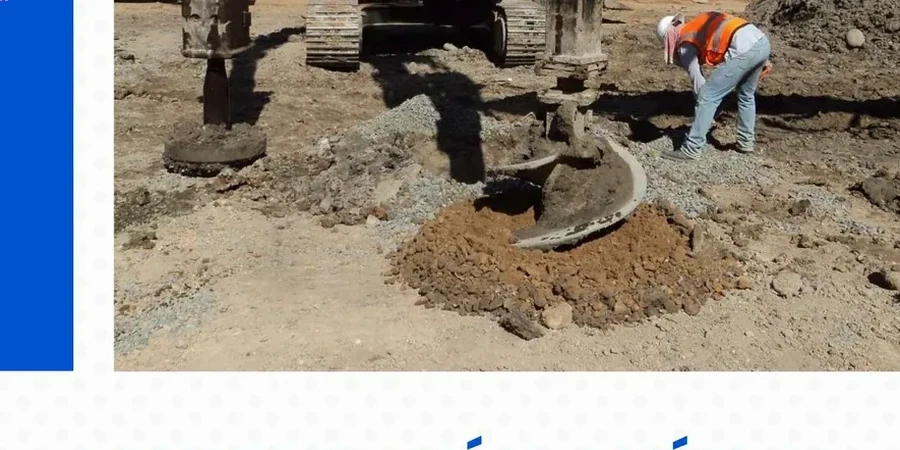
A crane-mounted vibrator with a bottom-feed hopper arrives on site, and the first two columns tell us whether the design assumptions hold. The operator monitors amperage draw in real time; a sudden drop below 150 amps in the upper 10 feet often indicates loose, uncemented sands that need a second pass. In Tucson’s older alluvial fans—particularly near the Rillito River—we have encountered buried debris and cobble lenses that deflect the vibrator off vertical. That is where the risk lives: a column installed out of plumb loses confinement at depth, and the composite stiffness degrades. Our field supervisor logs refusal depth, stone consumption per linear foot, and vibration time for every column, cross-referencing those numbers against the geotechnical baseline report. When stone take exceeds 120 percent of the theoretical volume, we flag the zone for a post-treatment plate load test to confirm the modulus before the structural slab is poured.
Quick answers
How much does stone column design and testing cost for a commercial lot in Tucson?
For a typical commercial building pad in the Tucson area, the combined geotechnical investigation, stone column design report, and post-installation verification testing runs between US$1,410 and US$5,470 depending on the number of borings and the depth of the treatment zone. A small retail site with two borings and one plate load test will fall on the lower end; a multi-acre industrial facility requiring CPT soundings, triaxial testing, and multiple modulus checks approaches the upper end.
How do you decide between stone columns and rigid inclusions in Tucson soils?
The decision hinges on the fines content of the native soil and the allowable total settlement. Stone columns rely on lateral confinement from the surrounding ground, so they work best when the matrix has less than 15 percent passing the No. 200 sieve. In Tucson’s finer basin-fill deposits near the Santa Cruz floodplain, we often see silt contents above that threshold, which reduces the column’s stiffness. When settlement tolerances are tight—under half an inch—we evaluate rigid inclusions as an alternative because they transfer load to a deeper bearing stratum rather than densifying the surrounding mass.
What verification testing is required after stone column installation in Tucson?
The City of Tucson typically follows IBC requirements, which call for a combination of modulus tests and penetration testing. We perform plate load tests on at least one column per 5,000 square feet of treated area to measure the deformation modulus directly. Between columns, we drill SPT borings and compare blow counts to the pre-treatment values; a ratio of 1.5 or higher in the upper 15 to 20 feet is the common acceptance criterion. When the project is in Seismic Design Category D, we also run cross-hole shear wave velocity profiles to confirm that the improved ground meets the site class assumptions used in the structural design.