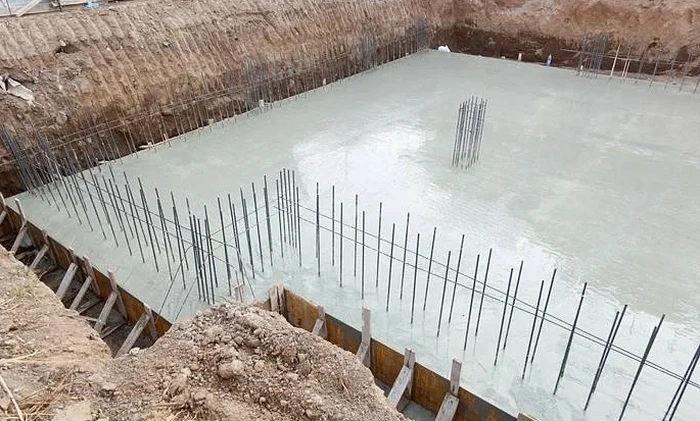
The Sonoran Desert teaches you patience. In Tucson, where summer monsoons blast bone-dry arroyos into flash floods, the soil doesn't forget the violence of water. What looks like stable ground in June can heave and crack by August if your foundation design ignores the desert's split personality. We see it every season—cracks propagating from stem walls because the subsurface wasn't read correctly. A proper shallow foundation design here starts with understanding the crust. That dense, cemented caliche layer that laughs at a backhoe might be your best bearing stratum. Or it might be a brittle cap over softer, collapsible silts. Our team has cored through enough Tucson subdivisions to know the difference. We tie every recommendation back to in-situ data, often combining our designs with test pit investigations to visually log the caliche profile and measure actual layer thickness before committing to a footing depth.
In Tucson, the most expensive mistake is treating caliche like bedrock. It's a soil horizon—strong but soluble. Your footing depth must consider both its bearing capacity and its dissolution potential under irrigation.
How we work
Tucson sits at roughly 2,400 feet elevation in the Santa Cruz Valley, ringed by bajadas that have been shedding sediment for millennia. The city's population has pushed past 500,000, driving construction into the foothills where soils are a mixed bag of weathered granite, cemented gravels, and pockets of clay. Our shallow foundation designs have to handle this variability without over-excavating the budget. We rely heavily on the bearing capacity verification from a
plate load test when dealing with heterogeneous fills, especially in older neighborhoods near the Rillito River where undocumented backfill is common. The design process also integrates laboratory index testing—specifically
grain size analysis and Atterberg limits—to classify the material and predict volume change potential. A foundation in the Tanque Verde area, sitting on coarse fan deposits, behaves nothing like one near the floodplain of the Santa Cruz, and our subgrade preparation reflects that.
Local ground factors
What catches people off guard isn't the big washout—it's the slow, silent differential movement. In Tucson, we commonly see edge-lift heaving in slab-on-grade foundations where the center of the slab stays dry and the perimeter gets landscaping drip. The soil swells locally, and suddenly you have a hinge line forming under the living room tile. Another risk we frequently diagnose is near-surface collapse. Fine-grained desert silts, when flooded by a broken irrigation line or a monsoon downpour, lose their apparent cohesion and drop the ground a few inches. A rigid footing spanning over that void now has a cantilever problem it wasn't designed for. Our shallow foundation design explicitly addresses these local failure modes—specifying moisture barriers, flexible utility connections, and reinforcing schedules that account for Tucson's specific shrink-swell cycles. We also lean on our slope stability analysis capability when the build site sits at the edge of a terrace or an arroyo bank, ensuring the foundation isn't undermined by lateral erosion over the next decade.
Quick answers
What is the typical depth for a shallow foundation in Tucson's desert soils?
It depends on the proximity to caliche. In many areas, a competent caliche layer exists within 18 to 36 inches of the surface, providing excellent bearing. However, if expansive clays are present above the caliche, we typically specify a minimum embedment of 24 inches below finished grade to get below the active zone of seasonal moisture fluctuation. The exact depth must be confirmed by test pit or boring data.
How much does a shallow foundation design package cost for a Tucson home?
For a typical single-family residential lot in the Tucson metro area, a complete shallow foundation design package—including soil investigation, laboratory testing of samples, engineering analysis, and stamped construction drawings—generally falls in the range of US$2,080 to US$2,730. The final cost depends on lot access, the number of borings or test pits required, and the structural complexity of the home.
Do you need to reinforce footings differently because of the caliche?
Not because of the caliche's strength, but because of its variability. Caliche layers in Tucson are notoriously undulating and can dissolve if irrigation water is slightly acidic. We design reinforcement to bridge over potential soft spots or solution cavities in the caliche, preventing a sudden brittle failure. We also typically specify a layer of compacted fill between the bottom of the footing and the raw caliche to create a uniform bearing surface.