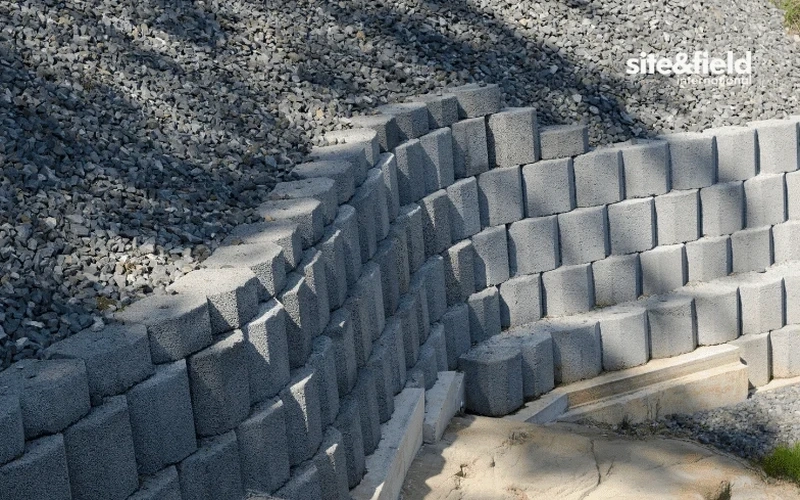
You can drive fifteen minutes in Tucson and go from the dense silty clays of the Santa Cruz floodplain to the cemented caliche caps up in the Catalina Foothills. That kind of variability is exactly why a standard retaining wall detail pulled from a manual almost never works here. In the basin areas near downtown and along the Rillito, the soils hold moisture and swell after monsoon storms; we have measured expansion pressures above 4,000 psf on samples from the Speedway corridor. Up in the foothills, the challenge flips to excavation difficulty and boulder content. A reliable retaining wall design in this city has to start with a boring log that captures that specific subsurface — not a generic assumption. We combine our lab data on plasticity and shear strength with site-specific SPT drilling to define the active wedge before a single block is placed.
In Tucson's basin soils, the difference between a stable wall and a leaning one is often just a few degrees of backfill friction lost to saturation.
Local ground factors
A few years back we were called out to a commercial project off Oracle Road where a block wall had rotated nearly four inches at the top after a single monsoon season. The original design assumed a free-draining backfill, but the contractor had used site-excavated silty clay with no chimney drain. Water built up behind the wall, saturated the backfill, and tripled the lateral load. The fix involved a full rebuild with a graded filter zone and weep holes at the base, but the owner lost months and a significant chunk of the original budget. In Tucson, the risk isn't the wall itself — it's what happens behind the wall when a summer storm hits. We see the same pattern repeated in the Rincon Valley and along Pantano Wash: drainage details matter more than the structural section. Because the city sits in Seismic Design Category B per the IBC, we also apply a pseudo-static increment to the Coulomb wedge when the retained height exceeds six feet.
Quick answers
What type of retaining wall works best in Tucson's expansive soils?
In high-PI clays, we typically recommend a cantilever or counterfort wall with a granular backfill wedge and a positive drainage system. The key is isolating the wall from the expansive native soil behind it — a vertical zone of clean, free-draining gravel with a filter fabric wrap prevents swelling pressure from acting on the stem. Gravity walls can work, but they need a deep enough embedment to resist sliding when the bearing soil softens after rain.
What does a retaining wall design cost in Tucson?
For a typical residential or light commercial wall in Tucson, the geotechnical investigation and design report runs between US$1,080 and US$4,250, depending on wall height, proximity to arroyos, and the number of borings required. Taller walls or those supporting structures above trigger additional slope stability and seismic checks, which fall toward the upper end of that range.
Do Tucson building codes require a geotechnical report for a retaining wall?
The City of Tucson and Pima County both reference the IBC, which requires a geotechnical investigation for walls over four feet in height or any wall supporting a surcharge. Even for shorter walls, we recommend at least a shallow exploration — the cost of a report is negligible compared to the liability of a failure, especially in neighborhoods with known expansive soils like Sam Hughes or El Encanto.
How do you handle caliche layers during retaining wall construction?
Caliche presents a mixed blessing. When it's massive and continuous, it can serve as a bearing stratum with strengths comparable to weak rock, and we'll set the footing directly on it after chiseling a level surface. But caliche in Tucson often occurs as discontinuous lenses — you might hit it at three feet in one corner and not find it at five feet in another. We map the top of the competent layer with borings at each wall corner and specify overexcavation limits if the lens is too thin or fractured to be reliable.