← Home · Laboratory

Triaxial Testing in Tucson: Shear Strength for Foundation Design

Together, we solve the challenges of tomorrow.

LEARN MORE →

A three-story medical office on the east side of Tucson sat on a patch of reddish-brown clay with visible caliche nodules. The developer needed bearing capacity numbers fast, and SPT blow counts alone weren't going to cut it for a deep foundation analysis. We mobilized the Shelby tubes, extruded undisturbed samples in the lab, and ran a consolidated-undrained triaxial test to nail down the effective stress parameters. That data fed directly into the footings design, saving the structural team from overconservative assumptions that would have added weeks to the piling schedule. In Tucson's basin-fill geology, where cohesive layers alternate with cemented gravels, the triaxial test remains the most reliable way to separate apparent cohesion from true drained strength.

Effective cohesion in Tucson caliche can drop by 40% once the sample is fully saturated and sheared slowly enough to dissipate pore pressure.

How we work

The triaxial test is essential when the project crosses into the Santa Cruz River floodplain or the older piedmont deposits near the Catalina Foothills. We run three specimen types routinely: unconsolidated-undrained (UU) for short-term stability during construction, consolidated-undrained (CU) with pore pressure measurement for staged loading, and consolidated-drained (CD) for long-term slope assessment. Each specimen is trimmed to a 2.8-inch diameter, saturated under backpressure, and sheared at a controlled strain rate per ASTM D4767. For projects dealing with collapsible soils near the Tanque Verde fan, we often pair the triaxial program with a CPT test to correlate laboratory strength with continuous in-situ tip resistance, giving the geotechnical engineer a full picture of the subsurface before the retaining walls go to final design.
Triaxial Testing in Tucson: Shear Strength for Foundation Design
Technical reference image — Tucson

Local ground factors

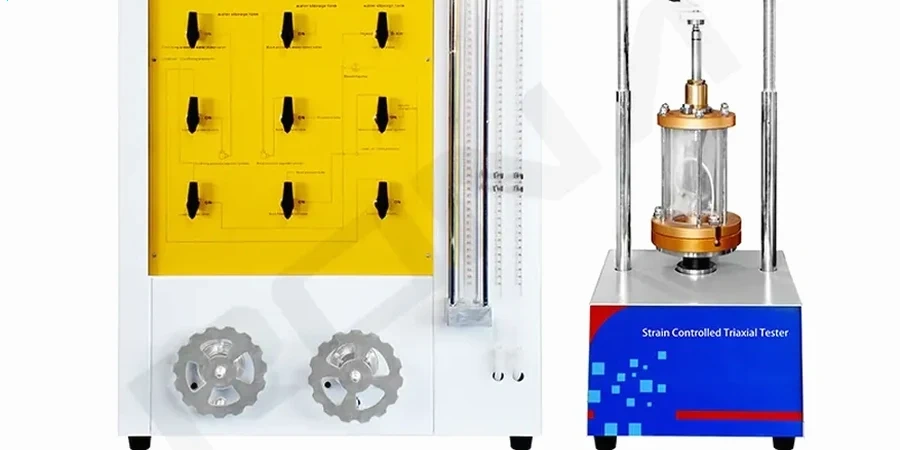
The triaxial cell in our Tucson lab runs on a closed-loop servo system that applies confining pressure through de-aired water while a load frame drives the piston at micrometer precision. When a specimen fails prematurely because a thin caliche seam sheared before the clay matrix mobilized full strength, the stress-strain curve tells the story immediately. That's the kind of failure mode you miss entirely with pocket penetrometer checks or index tests alone. We've seen projects on the northwest side where design friction angles were overestimated by six degrees because the original investigation relied on SPT correlations without a single triaxial confirmation. Six degrees doesn't sound like much until you're looking at a 30-foot basement excavation with shoring that was supposed to work on paper.

Need a geotechnical assessment?

Reply within 24h.

Email: info@geotechnicalengineering.sbs

Video overview

Reference parameters

ParameterTypical value
Specimen diameter2.8 in (71 mm)
Test types offeredUU, CU, CD per ASTM D4767
Saturation methodBackpressure increment until Skempton B ≥ 0.95
Strain rate (CU)0.005 to 0.02 in/min depending on soil permeability
Confining pressure range5 to 300 psi, multi-stage on request
MeasurementPore water pressure via electronic transducer
ReportingMohr circles, stress path, c' and φ' values

Related services

01

UU Triaxial Testing

Quick undrained shear strength for clay layers encountered during Tucson basement excavations, typically run at in-situ confining pressure with results in 5 business days.

02

CU with Pore Pressure Measurement

Effective stress parameters for foundation bearing capacity and slope stability analysis in the Pantano Wash corridor, following ASTM D4767 saturation and shear protocols.

03

Multi-Stage Triaxial Programs

Three specimens from the same Shelby tube tested at different confining pressures to build a complete Mohr-Coulomb envelope for Tucson's interbedded basin deposits.

Reference standards

ASTM D4767 (Consolidated Undrained Triaxial), ASTM D2850 (Unconsolidated Undrained Triaxial), ASTM D7181 (Consolidated Drained Triaxial), IBC 2024 Chapter 18 (Soils and Foundations)

Quick answers

How much does a triaxial test cost in Tucson?

A standard three-specimen CU triaxial program runs between US$2,020 and US$2,480 depending on whether we handle the Shelby tube sampling or you deliver extruded specimens. The price includes saturation, consolidation, shear, and a full report with Mohr circles, stress paths, and interpreted c' and φ' values.

What's the turnaround time for triaxial testing?

UU tests typically report in 5 business days. CU and CD programs take 10 to 14 business days because the consolidation and shear phases are rate-controlled. Silt layers common in Tucson basin soils drain slowly, so we won't rush the strain rate and compromise the pore pressure data.

Do we need triaxial testing or are SPT correlations enough?

SPT correlations work for preliminary design but Tucson's cemented soils and caliche layers skew blow counts upward. If your project involves a deep excavation, a structure sensitive to settlement, or a slope near the Santa Catalina foothills, the triaxial test gives you site-specific strength parameters that a correlation can't match.

What soil types can you test?

We test cohesive soils, silts, and fine sands from undisturbed Shelby tube samples across the Tucson basin. Clean gravels and rock require different methods. If your boring log shows gravel with cobbles, we'll recommend a CPT test or large-scale direct shear instead.
Location and service area

We serve projects in Tucson and surrounding areas.

View larger map