← Home · Investigation

Cone Penetration Testing (CPT) in Tucson: Desert Soil Profiling Without the Guesswork

Together, we solve the challenges of tomorrow.

LEARN MORE →

Tucson's soil profile rarely reads like a textbook. You get interbedded sands, cemented caliche lenses, and deep basin-fill sediments that shift behavior within a few vertical feet. Traditional drilling tells you something, but between sample intervals the ground can hide weak zones or dense crusts that control foundation performance. CPT fills those gaps. Our truck-mounted rig pushes a 15 cm² cone at a steady 2 cm/s, recording tip resistance, sleeve friction, and pore pressure simultaneously. In the Santa Cruz River corridor, where floodplain silts interlace with coarse channel deposits, we've seen the friction ratio flip from 1% to 5% across less than a meter. That detail matters for settlement calculations and for deciding whether a footing design needs reinforcement or just competent bearing strata. The Sonoran Desert's arid surface can mislead you too—dry crusts mask softer material beneath, and CPT catches that transition instantly.

CPT gives us a near-continuous signature of the subsurface—when caliche thickness varies by the meter across a site, that signature becomes the difference between over-excavation and a confident bearing stratum call.

How we work

Tucson's expansion eastward into Pantano Wash terraces and north toward the Catalina foothills means more projects encounter basin-and-range geology. The city sits at roughly 2,400 feet elevation, ringed by mountains that shed coarse alluvial fans onto the valley floor. These fans create abrupt stratigraphic contrasts: bouldery debris flows next to fine playa deposits. For standard SPT, cobble refusal stops the test. A CPT rig with a pre-drilled pilot hole through the top armor layer gets past that refusal and profiles the finer material below. We run seismic CPT modules when site-specific shear wave velocities are needed for site class determination per IBC. The data feeds directly into liquefaction analysis for projects near the Santa Cruz or Rillito washes, where shallow groundwater occasionally saturates loose Holocene sands—a scenario that triggers the simplified procedure from Seed & Idriss and the NCEER workshop updates we apply routinely.
Cone Penetration Testing (CPT) in Tucson: Desert Soil Profiling Without the Guesswork
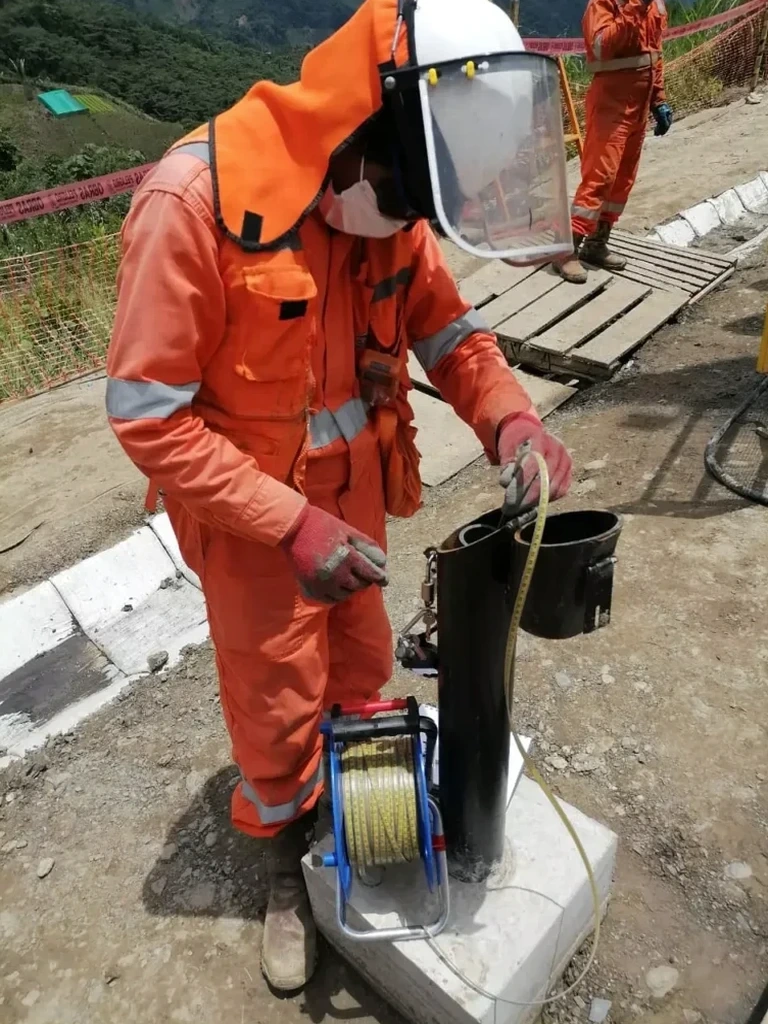
Technical reference image — Tucson

Local ground factors

The mistake we see repeatedly in Tucson is assuming caliche is a uniform bearing layer. Caliche forms as calcium carbonate precipitates from evaporating water—its top surface can be rock-hard, but thickness varies unpredictably and it often grades into weakly cemented silt with drastically lower bearing capacity. An engineer who specifies a pad footing on 'caliche' without confirming thickness and continuity risks differential settlement that cracks slabs and distorts framing. CPT catches the bottom of the caliche before the cone drops into softer material. Another risk: liquefaction screening skipped on sites above historically shallow groundwater. In the Rillito corridor, 100-year flood events raise the water table rapidly. Loose sands at 15 feet that test fine under dry conditions can lose strength when saturated. Running CPT with pore pressure measurement identifies these contractive layers so the design team can decide whether stone columns or densification is warranted before construction starts.

Need a geotechnical assessment?

Reply within 24h.

Email: info@geotechnicalengineering.sbs

Reference parameters

ParameterTypical value
Cone type15 cm² electronic friction cone (10 cm² optional)
Penetration rate20 mm/s ±5 mm/s per ASTM D5778
Measured channelsqc, fs, u₂ (pore pressure at shoulder)
Max push capacity20 tons (standard), 30 tons available
Friction ratio range0.5% to 8% (soil behavior type classification)
SBT charts appliedRobertson (1990, 2010) normalized for overburden
Typical profile depth50–80 feet in basin sediments, deeper with pre-drill

Related services

01

Seismic CPT (SCPTu) for Site Classification

Downhole shear wave velocity measurement integrated with cone data to determine IBC seismic site class. Critical for projects near known faults where Vs30 from correlations is insufficient. One push gives stratigraphy, soil behavior type, and dynamic properties.

02

Pore Pressure Dissipation Testing

Stopping the cone at target depths to record u₂ decay over time. Estimates coefficient of consolidation and helps distinguish drained from partially drained behavior in silty basin sediments. Used when settlement rate predictions matter for construction scheduling.

03

CPT for Deep Foundation Design

Direct estimation of pile side friction and end bearing from qc and fs profiles using methods from Eslami & Fellenius and ICP-05. Applies when Tucson projects require drilled shafts socketed into older basin deposits or when evaluating negative skin friction in consolidating fills.

Reference standards

ASTM D5778 – Standard Test Method for Electronic Friction Cone and Piezocone Penetration Testing of Soils, IBC 2021 – Site classification and seismic design parameters, ASCE 7 – Minimum Design Loads for Buildings (seismic site class from shear wave velocity), Robertson & Wride (1998) – CPT-based liquefaction triggering procedure (NCEER Workshop)

Quick answers

How much does a CPT investigation cost in Tucson?

Mobilization to the Tucson metro area plus testing typically ranges from US$160 to US$230 per sounding hour, depending on target depth, whether seismic or dissipation modules are added, and if pre-drilling through surface armor layers is required. A standard 60-foot push with pore pressure data commonly falls in the middle of that range. We provide a line-item proposal after reviewing the site geology and access conditions.

Can CPT penetrate Tucson's caliche layers?

Thin, moderately cemented caliche often yields to the 20-ton push without issue. Thick, densely laminated caliche may cause refusal. In those cases we pre-drill through the hard interval with a hollow-stem auger, then continue the CPT push in the softer material below. The refusal point itself is valuable data—it confirms the presence and depth of a competent hardpan.

How does CPT compare to SPT for Tucson basin sediments?

CPT provides a continuous profile of tip resistance and friction ratio, catching thin seams that standard split-spoon sampling at 5-foot intervals can miss. Tucson's interbedded silts and sands are well-suited to CPT, and the soil behavior type classification from Robertson's charts correlates reliably with our local sampling. SPT may still be needed if undisturbed samples for laboratory testing are required, but for stratigraphic detail and repeatability, CPT is the stronger first tool.

Do you run dissipation tests during every CPT sounding?

Not automatically. We include dissipation testing when the project requires consolidation or settlement rate estimates, or when the pore pressure response during penetration suggests partially drained conditions that affect interpretation. For straightforward bearing capacity profiling in dry granular soils, continuous push without dissipation stops is usually sufficient and keeps the program efficient.
Location and service area

We serve projects in Tucson and surrounding areas.

View larger map