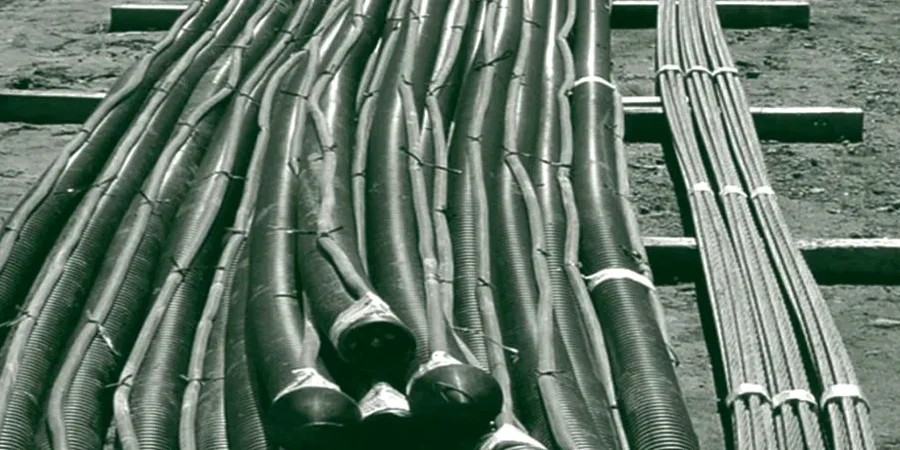
The most costly assumption we see in Tucson excavations is treating all ground anchors as if they work identically—ignoring the stark difference between active pre-stressing and passive reaction until deformation has already occurred. In cemented caliche layers and sandy alluvial fans typical of the Santa Cruz Valley, that mistake translates into shoring walls that move more than predicted, or tendon free lengths that lock off prematurely. Our design approach separates the load-transfer mechanics of each system: active anchors are tensioned against the structure to control movement from the start, while passive anchors only mobilize resistance once the retained soil mass begins to displace. Because Tucson’s subsurface alternates between hardpan horizons and loose granular lenses within the same excavation depth, we routinely integrate anchor pull-out tests with CPT soundings to map bond-zone variability before finalizing the unbonded length, and we cross-check seismic demand with liquefaction assessments when the water table is shallow in the Fort Lowell Formation.
An active anchor controls movement; a passive anchor reports it. In Tucson’s layered caliche, confusing the two can mean the difference between a locked-off tendon and a creeping wall.
Local ground factors
The contrast between downtown Tucson’s compacted terrace gravels and the loose floodplain deposits east of Pantano Wash illustrates how anchor risk shifts across short distances. On the terraces, passive anchors can develop resistance quickly because the soil fabric is dense and dilative; the challenge there is drilling through cobble-rich conglomerates without losing hole stability. East of the washes, fine-grained basin-floor sediments exhibit lower stiffness, meaning passive anchors may require several inches of wall movement before reaching design load—a condition that can damage adjacent utilities or historic adobe structures. The worst-case scenario we investigate is a bond zone partially seated in decomposed caliche that crumbles during tendon stressing, causing sudden load loss. Our risk mitigation includes water-pressure testing in the bond length to detect open fissures and a mandatory extended creep test whenever the grout-to-ground interface involves more than two distinct material types. Tucson’s summer monsoon season adds another variable: a partially excavated anchor trench filling with stormwater can soften the bearing stratum overnight, so we stage dewatering and shotcrete facing before anchor installation in the wettest months.
Quick answers
What is the difference between active and passive ground anchors?
Active anchors are tensioned against the structure before soil movement occurs, using a lock-off load to immediately restrain the wall. Passive anchors are not pre-stressed; they develop resistance only as the retained soil deforms and pulls on the tendon. In Tucson’s stiff caliche, active systems are preferred when movement tolerance is tight, while passive anchors can be economical in dense granular deposits where some displacement is acceptable.
How does Tucson’s caliche affect anchor bond capacity?
Caliche (pedogenic calcium carbonate) can bond exceptionally well to cement grout, often exceeding the capacity of the steel tendon itself. However, caliche layers are irregular and can be fractured or underlain by loose silt. We always perform proof tests because the apparent bond strength can drop sharply if the grout column enters a decomposed or vuggy zone within the hardpan.
What does anchor design and testing cost in Tucson?
Anchor design, load testing, and construction-phase verification typically range from US$960 to US$3,420 per anchor, depending on tendon capacity, access constraints, and the number of sacrificial test anchors required. Projects with complex corrosion protection or long free lengths in deep excavations fall toward the upper end of that range.
Do passive anchors work in Tucson’s basin-fill soils?
Yes, but their performance depends on the stiffness of the soil mass. In dense terrace gravels west of downtown, passive anchors mobilize quickly with minimal movement. In the finer silts and sands of the Fort Lowell Formation, especially east of Pantano Wash, passive systems may need several inches of wall displacement, so we model the load-deformation curve carefully and often recommend active pre-stressing if adjacent structures are sensitive.
What is an extended creep test and when is it required?
An extended creep test holds the anchor at its lock-off load for a minimum of 60 minutes while recording displacement at precise intervals. We require it whenever the bond zone crosses two or more materially different strata—a common situation in Tucson where caliche, sand, and clay lenses alternate within a single anchor length. The test confirms that creep stabilizes and the anchor will not lose load over time.