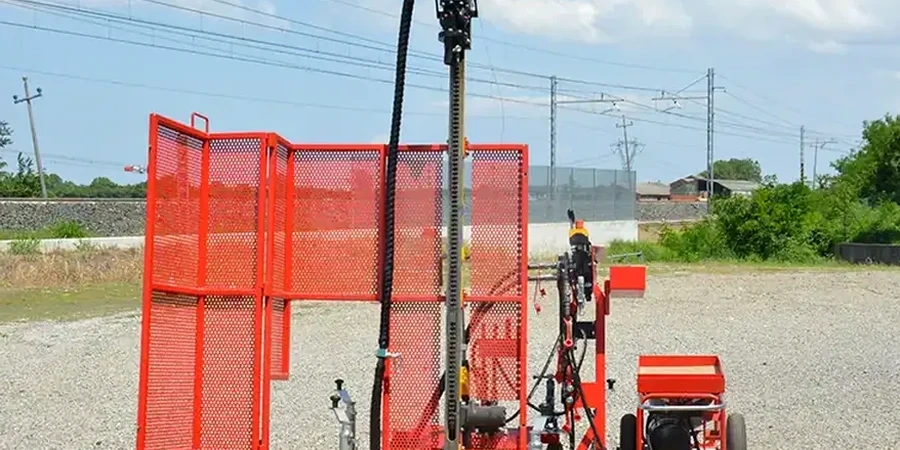
ASCE 7 and the IBC demand subsurface data before a single yard of concrete is poured in Tucson. The basin fill geology here is unforgiving — interbedded sands, silts, and gravels washed down from the Santa Catalinas over millennia. We run SPT borings per ASTM D1586 to cut through the guesswork. A 140-lb hammer falling 30 inches. Split-spoon sampler driven 18 inches. N-values recorded every 6 inches. That raw data translates directly to bearing capacity and liquefaction susceptibility. In a city that sits at 2,389 feet elevation atop up to 5,000 feet of alluvial sediment, skipping the SPT is not a risk any engineer should take. We frequently pair the SPT with a CPT test when the project demands continuous soil profiling through the heterogeneous interbeds common in the Tucson Basin.
SPT N-values in Tucson basin fill can shift from 8 to 45 within 10 vertical feet. That's the difference between a mat foundation and driven piles.
Local ground factors
Tucson's post-war expansion pushed subdivisions onto dissected alluvial fans east of Campbell Avenue, areas mapped as Quaternary surficial deposits. The geotechnical legacy includes undocumented cut-and-fill zones, old arroyo alignments buried under compacted fill, and hydro-collapsible silts near Pantano Wash. A structure founded on these materials without SPT verification faces differential settlement claims within the first five monsoon cycles. The 2006 flood events along the Rillito reminded everyone that subsurface water can move fast through granular basin deposits, scouring fines and reducing bearing capacity. We drill through the fill, hit natural ground, and give the structural engineer real N-values — not assumed soil parameters from a county soil survey map.
Quick answers
How much does an SPT boring program cost in Tucson?
A typical SPT investigation with two boreholes to 30 feet runs between US$530 and US$840 per hole, depending on access conditions and depth. Sites on steep alluvial fan slopes or with limited rig access may run higher due to setup time.
What depth do SPT borings need to reach for a Tucson building permit?
The IBC requires borings to extend below all compressible strata and at least to a depth where the stress increase from the structure is less than 10% of the existing overburden. In Tucson basin fill, this often means 30 to 50 feet for a two-story building, deeper for high-occupancy structures.
Can you drill through hard desert caliche with SPT equipment?
Yes. Caliche layers — calcium carbonate cemented soils common across Tucson — can be penetrated with a track-mounted CME rig. If the caliche exceeds the sampler's refusal criteria (50 blows per 6 inches), we switch to rock coring. We log the transition and report it clearly in the boring logs.
How long does an SPT field program take, and when do I get the report?
Two to three boreholes to 40 feet typically take one field day. Lab tests add 5 to 7 business days. You'll have a stamped geotechnical report in hand roughly two weeks from mobilization, faster if the project is urgent and we prioritize the lab schedule.