← Home · Ground improvement

Vibrocompaction Design in Tucson: Deep Compaction for Alluvial Basin Soils

Together, we solve the challenges of tomorrow.

LEARN MORE →

IBC Section 1803 requires a geotechnical investigation that addresses soil instability, and in the Tucson Basin that almost always means dealing with loose Holocene alluvium. The city sits on over 3,000 feet of basin fill—sand, gravel, and silty layers deposited by episodic sheet flooding off the Santa Catalina and Rincon mountains. These deposits can have relative densities below 40 percent, which spells differential settlement for shallow foundations. That is where vibrocompaction design comes in. We model the vibratory energy required to densify the target stratum, considering the depth to caliche, which in Tucson can appear anywhere from 2 to 15 feet below grade. For deeper cohesionless layers we often pair the vibrocompaction layout with a CPT test to verify tip resistance before and after treatment, and we rely on grain-size analysis to confirm the soil gradation falls within the compactable range—typically less than 12 percent fines for the vibratory method to be effective.

In the Tucson Basin we design for relative density targets above 70 percent, because anything less and the summer monsoons will find the weak spots.

How we work

The Sonoran Desert presents a compaction paradox: surface soils can be bone-dry with moisture contents below 3 percent, yet monsoon season runoff channels saturate localized lenses, creating perched water that kills vibratory energy transfer. Our vibrocompaction design accounts for this by specifying probe spacing tighter than the textbook square pattern when we encounter interbedded silty layers. We typically design triangular grids at 6 to 10-foot centers, using a variable frequency approach that starts at 30 Hz and ramps down as the probe advances. The target is to bring the SPT N-value above 25 blows per foot, documented by SPT drilling at the center of each compaction cell. For sites near the Rillito Wash or Pantano Wash corridors, where historical channel migration has left clean gravel pockets, we specify bottom-feed stone columns as a fallback if the vibrocompaction probe hits refusal on a buried boulder train. The compaction depth limit in Tucson is usually controlled by the groundwater table, which sits between 80 and 150 feet in the central basin.
Vibrocompaction Design in Tucson: Deep Compaction for Alluvial Basin Soils
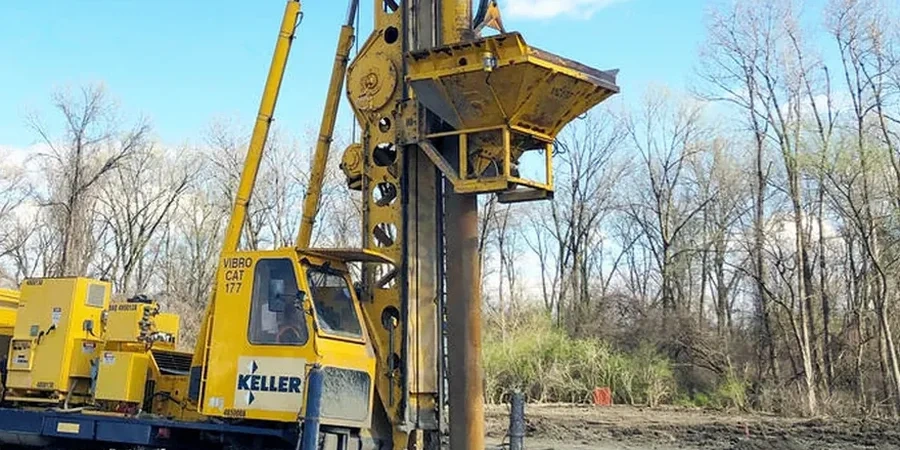
Technical reference image — Tucson

Local ground factors

A mistake we see too often in Tucson is vibrocompaction designed without a pre-treatment cross-hole seismic survey. Basin-fill stratigraphy here is not a neat layer cake; the Pantano Formation and Fort Lowell Formation interfinger in ways that create velocity inversions. If you assume uniform granular material from a few borings, you risk placing probes into zones where the vibration energy dissipates laterally through a silty matrix instead of densifying the sand. The result is a treated zone that passes a post-compaction SPT at the test location but still settles under load because untreated lenses remain. We map the subsurface with MASW before laying out the grid, confirming that the shear wave velocity profile supports the compaction radius we are modeling. Another local peculiarity: caliche layers in Tucson can be hardpan that blocks probe penetration, requiring pre-drilling through the carbonate crust before vibratory compaction can start in the underlying granular material.

Need a geotechnical assessment?

Reply within 24h.

Email: info@geotechnicalengineering.sbs

Video overview

Reference parameters

ParameterTypical value
Design methodIBC 2024 / ASCE 7-22 ground improvement provisions
Target relative density≥ 70% (Dr) for settlement-critical structures
Probe spacing (triangular)6 to 10 ft c-c, adjusted per CPT tip resistance
Typical treatment depth25 to 65 ft below grade (basin fill)
Min. SPT N-value post-treatmentN₁₆₀ ≥ 25 blows/ft
Gradation limit for fines< 12% passing #200 sieve (ASTM D2487)
Backfill typeClean sand or gravel, D₅₀ 1–3 in per ASTM D448

Related services

01

Deep Vibrocompaction Grid Design

We develop triangular or square probe layouts based on CPT and MASW data, specifying depth, frequency, amperage draw, and hold time per lift. Deliverables include a compaction plan sheet and a QA/QC testing schedule tied to post-treatment SPT borings and zone load tests.

02

Pre- and Post-Treatment Verification Testing

We execute the full verification sequence: cross-hole seismic before treatment, SPT or CPT at grid centers after compaction, and settlement monitoring plates for a minimum 30-day observation period. All data is reported against IBC acceptance criteria.

Reference standards

IBC 2024 Section 1803 (Geotechnical Investigations), ASCE 7-22 Chapter 20 (Site Classification and Ground Improvement), ASTM D1586 / D6066 (SPT and energy calibration), ASTM D2487 (Unified Soil Classification for fines cutoff), ASTM D4428/D4428M (Cross-hole seismic testing)

Quick answers

What soil types in Tucson are suitable for vibrocompaction?

Vibrocompaction works on granular soils with less than 12 percent fines passing the #200 sieve. Tucson's basin-fill alluvium—sands and gravels from the Santa Cruz River system and piedmont washes—generally meets this criterion. Silty units within the Fort Lowell Formation may not respond, which is why we run grain-size tests on split-spoon samples before committing to the method.

How long does a vibrocompaction treatment program take?

A typical 30,000-square-foot pad in Tucson takes 7 to 10 working days for the compaction phase, plus another 2 to 3 days for post-treatment SPT verification. The compaction trial adds one day at the start. Monsoon season can extend the schedule if saturated lenses require drainage or a switch to stone columns in wet zones.

What does vibrocompaction design cost for a project in Tucson?

Design fees for a vibrocompaction program in Tucson typically range from US$1,270 to US$5,540 depending on the treated area, depth, and verification testing scope. A small commercial lot under 10,000 square feet with standard grid layout and three post-treatment borings falls toward the lower end, while a multi-acre industrial site with MASW profiling, cross-hole testing, and extended settlement monitoring moves toward the upper end.

Can vibrocompaction trigger settlement on adjacent properties?

Yes, and in Tucson's older barrio neighborhoods with historic adobe construction, this is a real concern. We design a vibration monitoring plan with seismographs at property lines, limiting peak particle velocity to 0.5 in/sec per the standard industry criterion. If adjacent structures are within 50 feet of the treatment zone, we may reduce probe frequency or install a pre-excavated isolation trench.
Location and service area

We serve projects in Tucson and surrounding areas.

View larger map